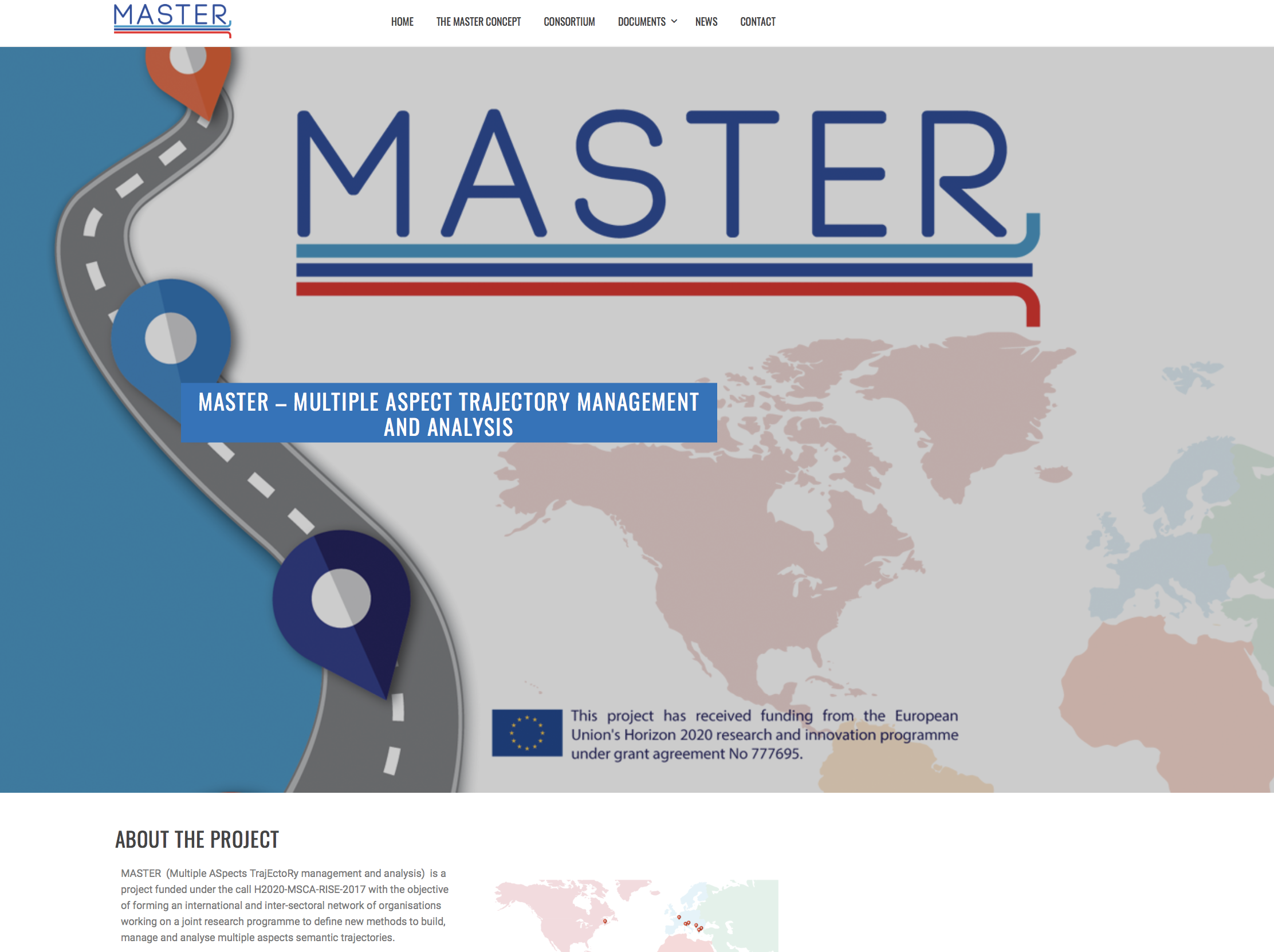
MASTER (Multiple ASpects TrajEctoRy management and analysis) is a project funded under the call H2020-MSCA-RISE-2017 with the objective of forming an international and inter-sectoral network of organisations working on a joint research programme to define new methods to build, manage and analyse multiple aspects semantic trajectories.
CHOROLOGOS aims at advancing the state-of-the-art in spatio-temporal-textual query processing, by introducing a novel framework that tightly combines spatio-textual and spatio-temporal querying with semantic retrieval, focusing on expressive query formulation beyond syntactical matching, efficient indexing and query processing, and scalable analysis of massive spatio-textual data.
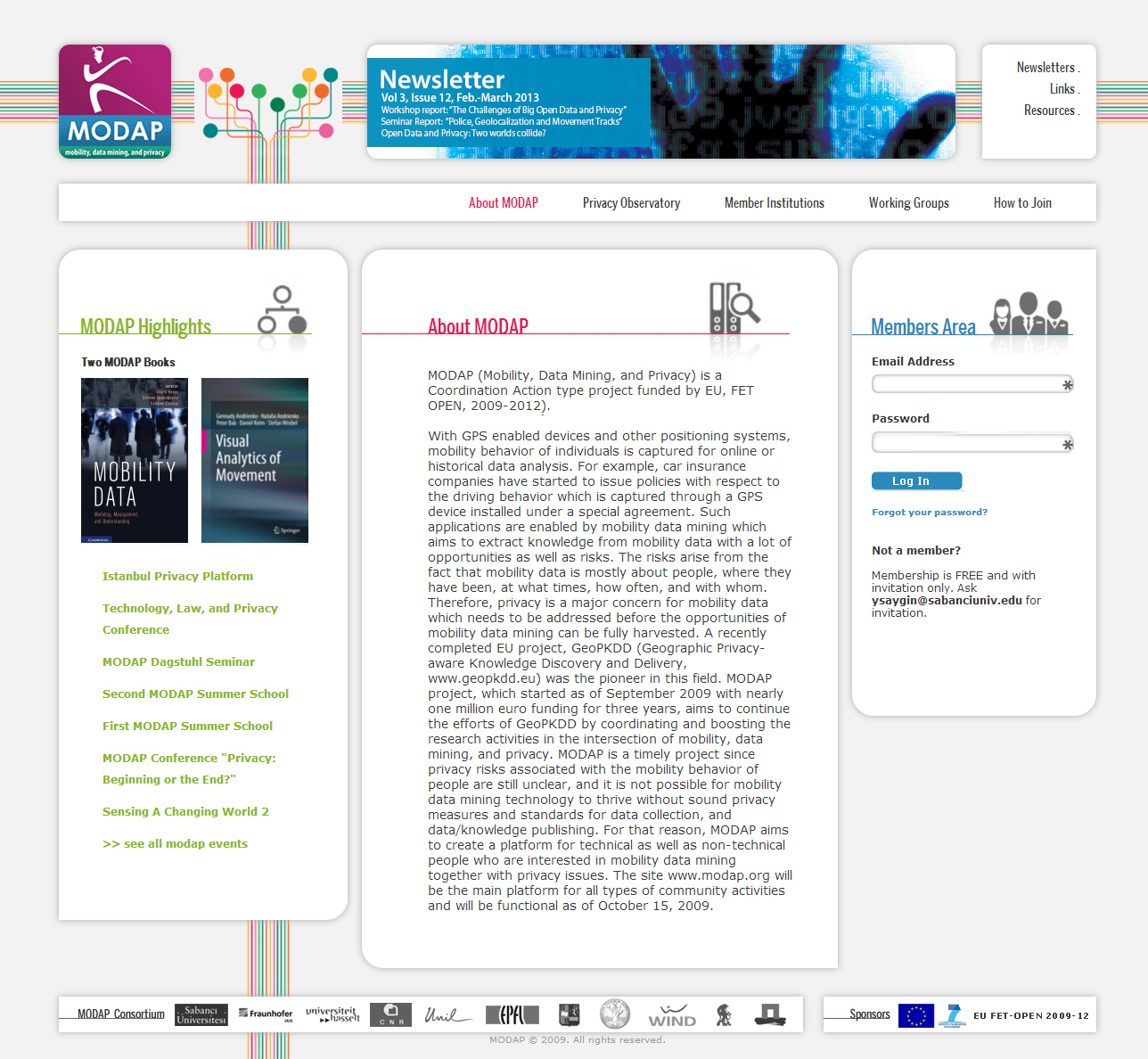
With GPS enabled devices and other positioning systems, mobility behavior of individuals is captured for online or historical data analysis. For example, car insurance companies have started to issue policies with respect to the driving behavior which is captured through a GPS device installed under a special agreement.
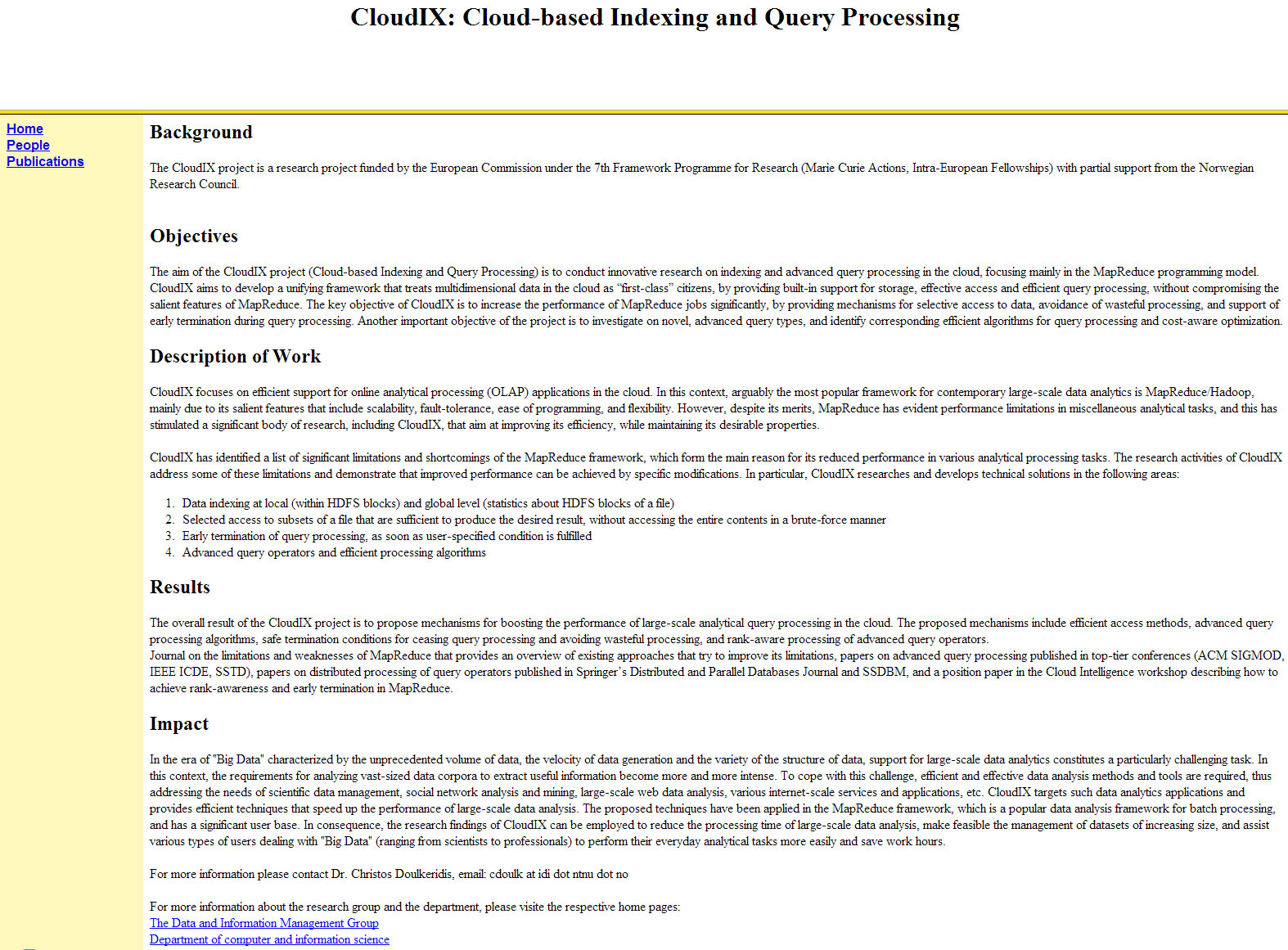
The aim of the CloudIX project is to conduct innovative research on indexing and advanced query processing in the cloud, focusing mainly in the MapReduce programming model. CloudIX aims to develop a unifying framework that treats multidimensional data in the cloud as “first-class” citizens, by providing built-in support for storage, effective access and efficient query processing, without compromising the salient features of MapReduce. The key objective of CloudIX is to increase the performance of MapReduce jobs significantly, by providing mechanisms for selective access to data, avoidance of wasteful processing, and support of early termination during query processing.
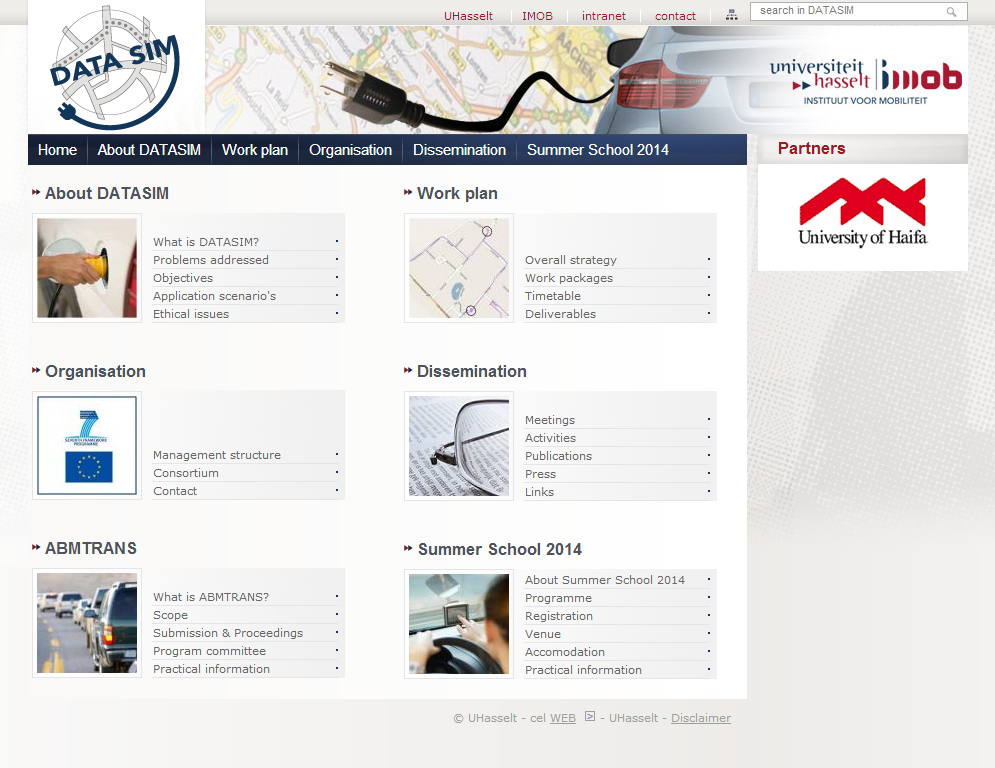
DATA SIM aims at providing an entirely new and highly detailed spatial-temporal microsimulation methodology for human mobility, grounded on massive amounts of Big data of various types and from various sources, e.g. GPS, mobile phones and social networking sites, with the goal to forecast the nation-wide consequences.
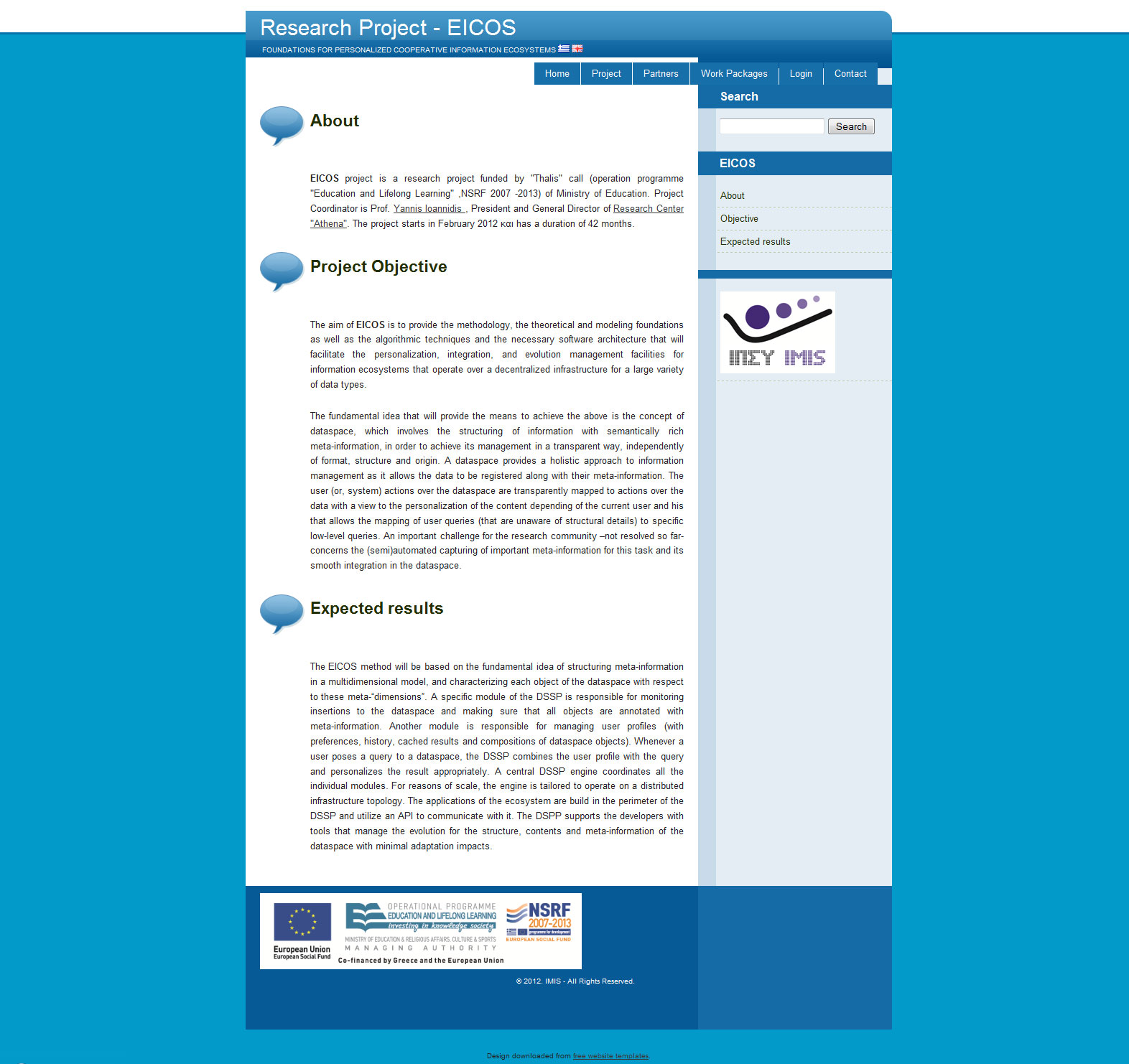
The aim of EICOS is to provide the methodology, the theoretical and modeling foundations as well as the algorithmic techniques and the necessary software architecture that will facilitate the personalization, integration, and evolution management facilities for information ecosystems that operate over a decentralized infrastructure for a large variety of data types.
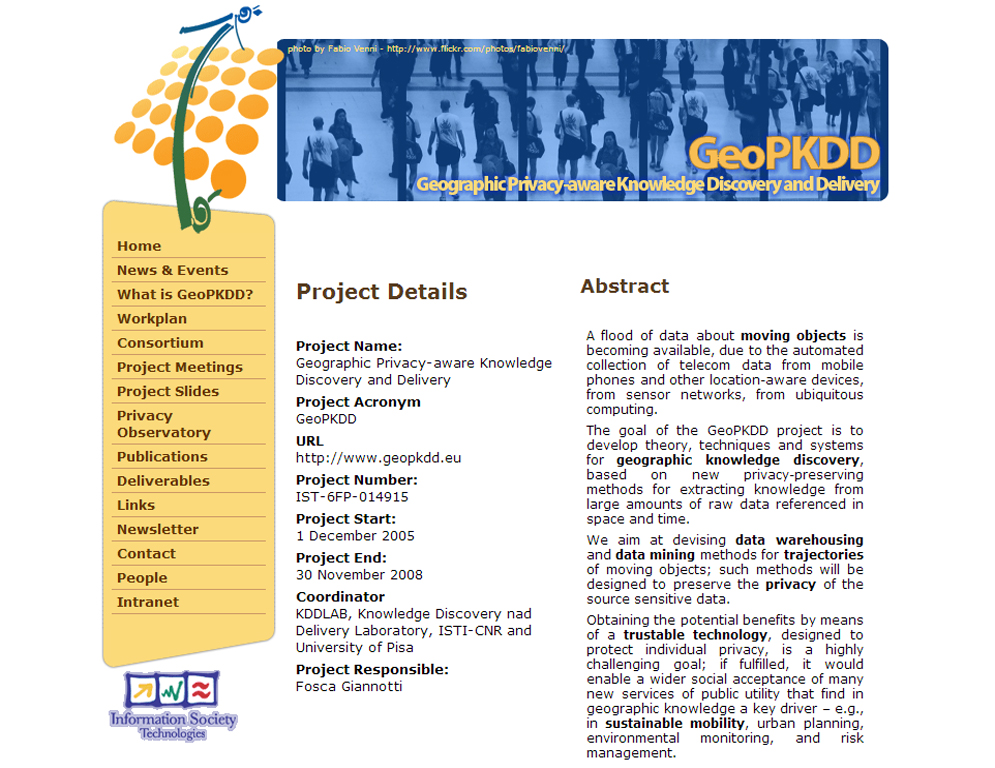
The general goal of the GeoPKDD project is to develop theory, techniques and systems for knowledge discovery and delivery, based on new automated privacy-preserving methods for extracting user-consumable forms of knowledge from large amounts of raw data referenced in space and in time.
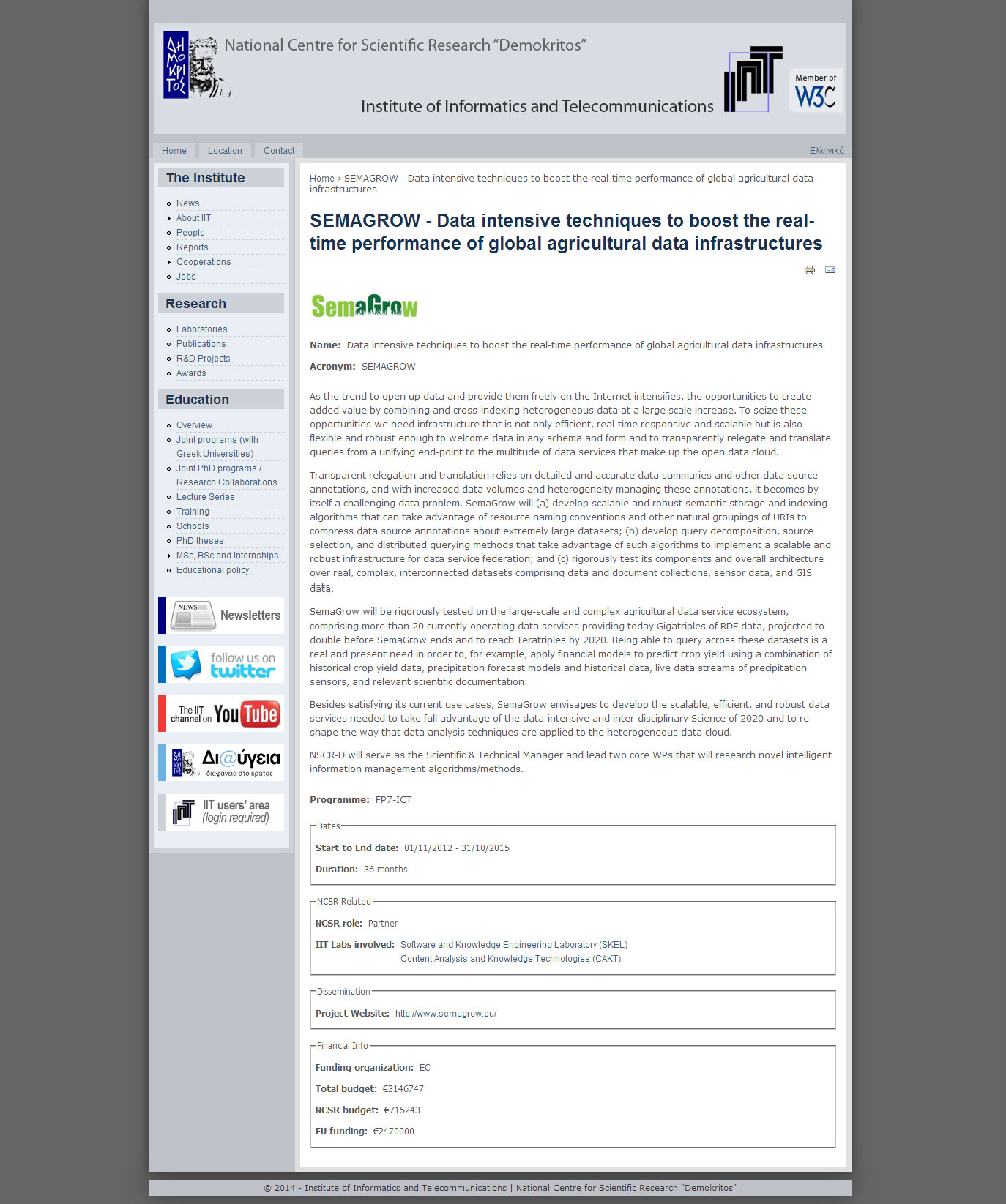
SemaGrow (a) develops scalable and robust semantic storage and indexing algorithms that can take advantage of resource naming conventions and other natural groupings of URIs to compress data source annotations about extremely large datasets; (b) develops query decomposition, source selection, and distributed querying methods that take advantage of such algorithms to implement a scalable and robust infrastructure for data service federation; and (c) rigorously tests its components and overall architecture over real, complex, interconnected datasets comprising data and document collections, sensor data, and GIS data. Our involvement in SemaGrow is on ontology alignment, emphasizing on user-related aspects and scalability issues.
A flood of data pertinent to moving objects is available today, and will be more in the near future, particularly due to the automated collection of data from personal devices such as mobile phones and other location-aware devices. Such wealth of data, referenced both in space and time, may enable novel classes of applications of high societal and economic impact, provided that the discovery of consumable and concise knowledge out of these raw data is made possible.
We use cookies on our website in order to provide a better experience and to help us improve. By clicking “Accept”, you consent to the use of ALL the cookies.
This website uses cookies to improve your experience while you navigate through the website. Out of these, the cookies that are categorized as necessary are stored on your browser as they are essential for the working of basic functionalities of the website. We also use third-party cookies that help us analyze and understand how you use this website. These cookies will be stored in your browser only with your consent. You also have the option to opt-out of these cookies. But opting out of some of these cookies may affect your browsing experience.
Necessary cookies are absolutely essential for the website to function properly. These cookies ensure basic functionalities and security features of the website, anonymously.
Cookie
Duration
Description
cookielawinfo-checkbox-analytics
11 months
This cookie is set by GDPR Cookie Consent plugin. The cookie is used to store the user consent for the cookies in the category "Analytics".
cookielawinfo-checkbox-functional
11 months
The cookie is set by GDPR cookie consent to record the user consent for the cookies in the category "Functional".
cookielawinfo-checkbox-necessary
11 months
This cookie is set by GDPR Cookie Consent plugin. The cookies is used to store the user consent for the cookies in the category "Necessary".
cookielawinfo-checkbox-others
11 months
This cookie is set by GDPR Cookie Consent plugin. The cookie is used to store the user consent for the cookies in the category "Other.
cookielawinfo-checkbox-performance
11 months
This cookie is set by GDPR Cookie Consent plugin. The cookie is used to store the user consent for the cookies in the category "Performance".
viewed_cookie_policy
11 months
The cookie is set by the GDPR Cookie Consent plugin and is used to store whether or not user has consented to the use of cookies. It does not store any personal data.
Analytical cookies are used to understand how visitors interact with the website. These cookies help provide information on metrics the number of visitors, bounce rate, traffic source, etc.